
Ever noticed a gorgeous website that actually provides very little critical information? It’s like sitting in a gorgeous Ferrari but staying in the showroom. It never gets you where you need to go. Frustrating. Likewise, well-constructed websites can prioritize function and yet under-cut credibility because they look terrible. We have an old truck on the farm that will get you to town and back, but it’s a rough ride, and it doesn’t turn any heads. It’s the old form/function dilemma. The good news is: we don’t have to pick. Beautiful, high-performing websites that showcase the company’s quality are within reach. We don’t tolerate clunkers, and we don’t make art pieces that sit still. Websites can do both.
A B2B website earns credibility with self-directed buyers through specificity, transparency, and third-party proof, not through polish alone. Buyers researching an engineering or industrial vendor are scanning for evidence they can verify: relevant project experience, honest information about scope and limitations, visible certifications, and a real team behind the name. A site that only looks professional but can’t be verified gets treated the same as one that looks amateur. Both get closed, and the buyer moves to the next tab. Not good.
That distinction matters more than most companies realize. In our previous post on why referral-based growth stalls, we covered the data showing B2B buyers now complete roughly 60% of their decision before contacting a vendor. This post picks up exactly where that leaves off: if the bulk of the deciding happens before your team ever says a word, what is the buyer actually evaluating during that silent 60%? Mostly, in the 21st century, that’s your website.
Your Website Is Already Making the Pitch, Whether You Built It To or Not
Every engineering and industrial firm has a pitch its sales team has refined over years. The right proof points, the right order, reading the room. Almost none of them have translated that same discipline to their website. The result is a homepage that talks about “excellence” and “quality service” while the actual pitch — the one that wins deals in person — never makes it online.
New buyers don’t know your sales team’s pitch. They only know what the site shows them. If the website is vague, generic, or indistinguishable from ten competitors, that’s the pitch a self-directed buyer receives, regardless of how sharp your team is on a call.
What Self-Directed Buyers Are Actually Scanning For
Research into B2B trust signals consistently points to a handful of things buyers look for before they’ll take a vendor seriously, and none of them are about how modern the site looks:
Specificity over superlatives. “Industry-leading” and “trusted partner” are unverifiable, and most buyers know it. Specific project types, specific scopes of work, and specific outcomes are checkable. Those claims are the ones buyers believe.
Honesty about limitations. This is counterintuitive, but it’s backed by real research. A TrustRadius study on B2B technology buyers found that vendors who were open about where their product wasn’t a fit were more likely to close deals than vendors who oversold. Buyers don’t expect a company to be the right fit for everyone, but they trust a company to tell the truth about who it’s actually right for.
Third-party validation. Certifications, licenses, industry association memberships, and compliance documentation matter more in industrial and engineering contexts than almost anywhere else. As one B2B website trust analysis puts it, whether you’re in manufacturing, engineering, construction, or professional services, buyers are protecting more than company money when they choose a vendor. They’re protecting their own judgment and their own career if the choice goes badly. A verifiable credential does more to reduce that personal risk than any amount of persuasive copy.
A visible, real team. Buying committees for meaningful B2B purchases have grown well beyond a single decision-maker, often into double digits across departments. Several of those people will look at a site searching for the people they’d be working with. A site with no names, no faces, and no LinkedIn presence reads as a company hiding behind its own brand.
“Looking Professional” and “Being Credible” Are Not the Same Thing
This is where a lot of website investment gets wasted. A visually polished site with generic stock photography, vague claims, and no specific proof can look more “credible” at a glance than a plainer site packed with real project details, named engineers, and verifiable certifications. Naturally, buyers will still trust the plainer one more once they start actually reading.
This is worth sitting with if you’re skeptical of marketing in general: the fix here isn’t more creative polish. It’s more proof, presented clearly. That’s a positioning and content problem before it’s a design problem.
A 6-Question Self-Audit
Before redesigning anything, pull up your own site and answer these six brief questions honestly:
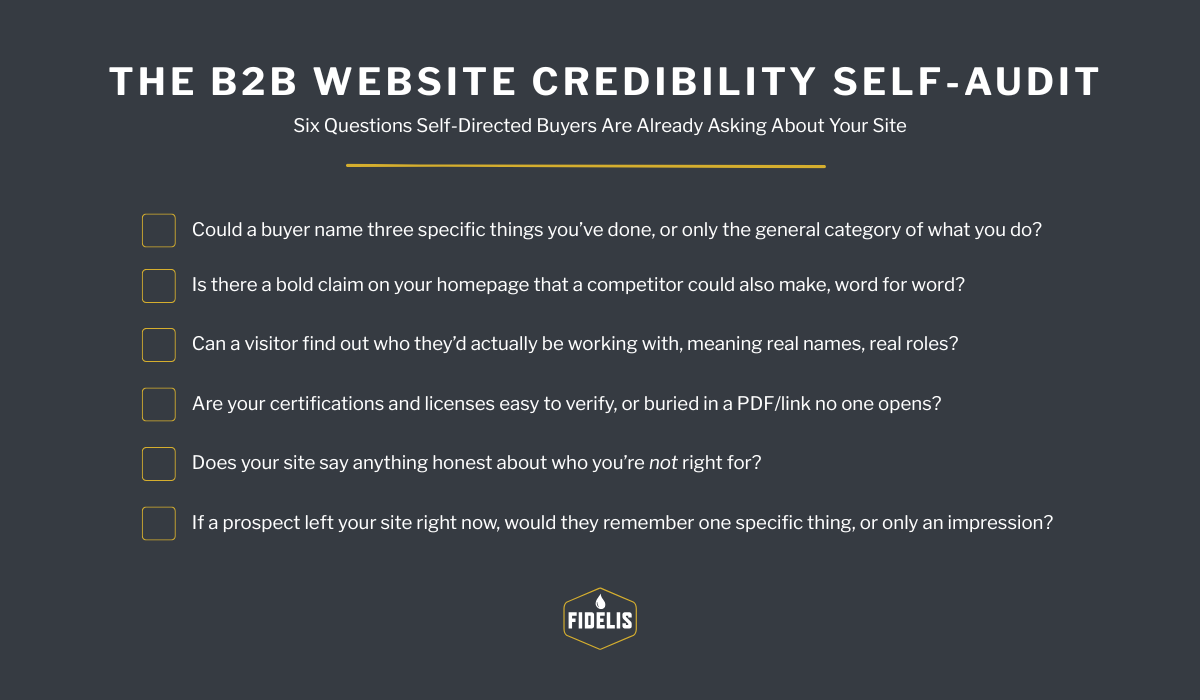
If most of your answers feel uncheckable, it might be time to rethink your website’s copy and design. Ideally, the two should work together.
What This Looks Like for Engineering & Industrial Firms Specifically
Generic B2B advice doesn’t fully translate to this world, so a few things worth calling out directly:
- Licensing and stamps matter more than most industries. PE licensure, bonding capacity, safety records (EMR/OSHA data), and relevant certifications are checkable facts buyers actively look for. Make sure to feature them where potential buyers will see them.
- Project specificity beats portfolio breadth. A buyer evaluating you for a specific project type wants to see that exact type of work, not a broad gallery implying you do everything reasonably well.
- Response cadence is a trust signal too. If your site implies a boutique, high-touch relationship but a contact form goes three days without a reply, that mismatch is itself a credibility problem. Buyers notice when behavior doesn’t match positioning.
FAQ
What makes a B2B website trustworthy to buyers who haven’t spoken to sales yet? Specific, verifiable claims carry more weight than polished design or generic marketing language. Named team members, visible certifications, honest scope limitations, and concrete project details are important.
Does website design matter less than content for B2B credibility? Design still matters for usability and first impressions, but research shows buyers ultimately trust vendors who are specific and honest over vendors who simply look the most polished. Design without substance underneath it doesn’t hold up once a buyer starts reading closely.
Why do engineering and industrial buyers care so much about certifications? Because the purchase carries real technical and career risk. A verifiable license or certification reduces that risk in a way persuasive copy can’t. It’s proof a third party has already checked your work.
How much of the B2B buying decision happens before a vendor is contacted? Independent research from 6sense’s 2025 Buyer Experience Report puts it at roughly 60% of the journey completed before first contact, which is why the website itself functions as the first, and sometimes deciding, sales conversation.
This is the second post in a short series on building a marketing system that doesn’t depend on referrals or guesswork — start with “Why Referral-Based Growth Stalls” if you missed it. For more on positioning, web credibility, and sales enablement, visit the Fidelis blog or see how we approach marketing engines on our marketing systems page. We’re also on LinkedIn, Instagram, and YouTube.
Do you need help
talking to your
perfect clients?